Discovering the Mosque of the Clouds
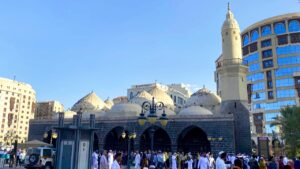
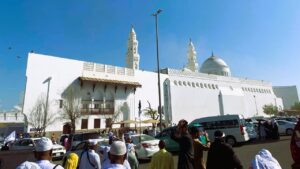
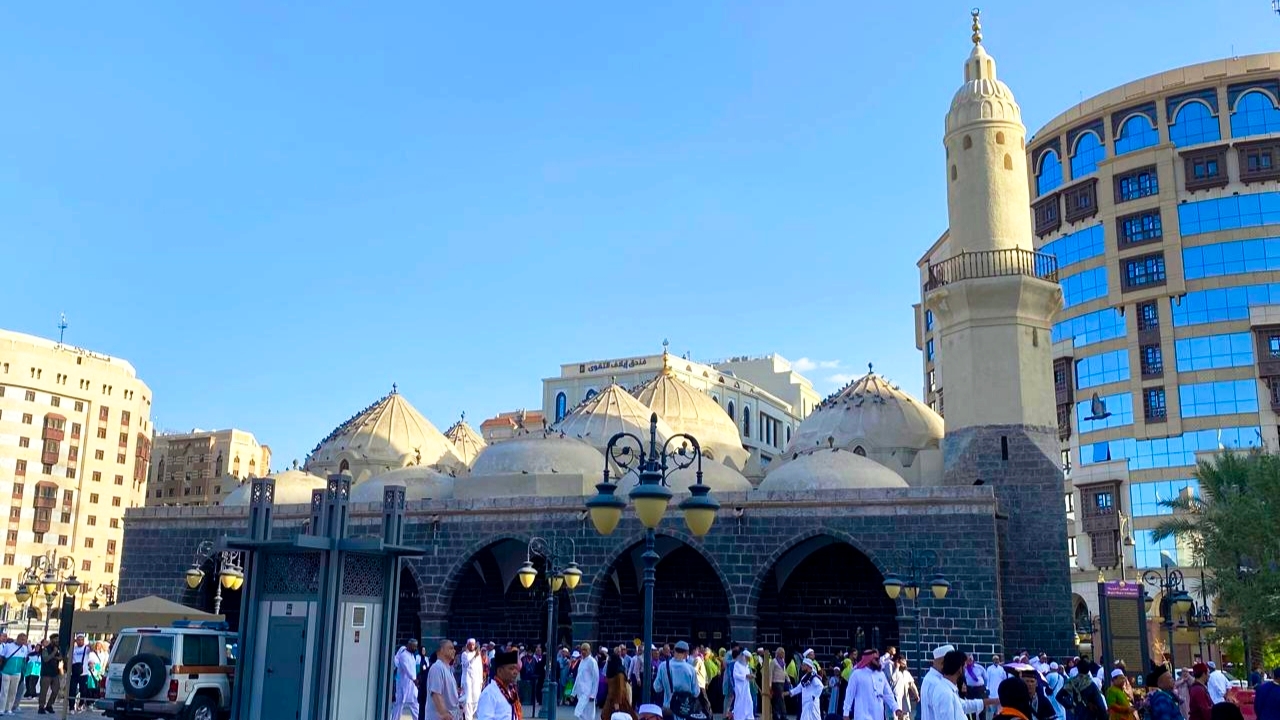
✨If you walk just a few hundred meters southwest of the Prophet’s Mosque (Masjid an-Nabawi) in Medina, you’ll encounter a building that feels like a quiet whisper from the past. With its dark volcanic basalt walls and multiple grey domes, Masjid Al-Ghamama stands as a beautiful testament to a moment of divine intervention.
Known as the “Mosque of the Clouds,” this site isn’t just an architectural gem. Indeed, it’s a place where history and faith meet in a very literal way.
The Story Behind the Name
The word Ghamama translates to “cloud” in Arabic. Tradition holds that the exact location of Masjid Al-Ghamama is where Prophet Muhammad (PBUH) performed the Salat al-Istisqa (a prayer for rain) during a period of severe drought in Medina.
According to historical accounts, as soon as the Prophet finished the prayer, clouds gathered over this specific spot. Subsequently, heavy rain began to fall, bringing relief to the city.
Why It’s Historically Significant
Beyond the miracle of the rain, Masjid Al-Ghamama holds several layers of importance:
- The Eid Prayers: For the final years of his life, the Prophet (PBUH) frequently performed the Eid prayers at this Masjid Al-Ghamama site. Back then, this site was an open plain on the outskirts of the city.
- The Janazah of Najashi: It is believed that this is where the Prophet (PBUH) performed the Janazah (funeral prayer) in absentia for Najashi, the King of Aksum (Abyssinia). Najashi had protected early Muslim migrants.
- Architectural Heritage: While the site dates back to the 7th century, the current structure is primarily the result of Ottoman-era craftsmanship. Its use of black basalt stone gives it a distinct look compared to the white marble of the neighboring Masjid an-Nabawi.
Visiting Today
Today, the mosque no longer hosts the five daily prayers because of its proximity to Masjid an-Nabawi. However, Masjid Al-Ghamama remains a vital stop for pilgrims and history buffs. It serves as a visual “time capsule,” showing how Medina looked before the massive modern expansions.
Walking through the courtyard of Masjid Al-Ghamama, you can almost imagine the old city limits of Medina. It’s a place for reflection, away from the bustling crowds of the main mosque.